Ethan Cowan
About Archive Photos Reading Subscribe Also on Micro.blog
  • Three Heres, Three Nows

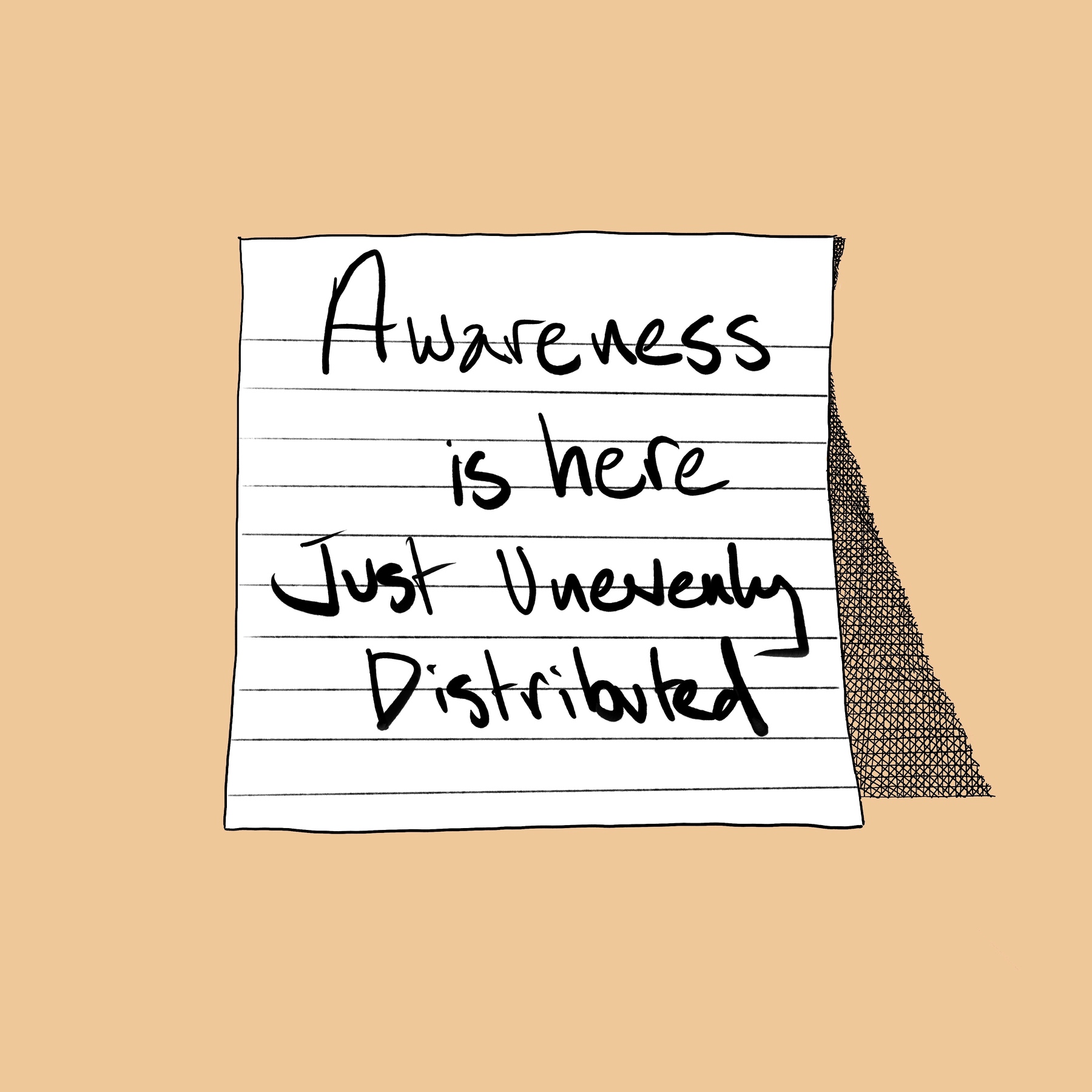
    What if the two sides are never the same?

    I’m talking to the mother. I already brought up how awkward I felt last time when I clammed up. That was when she told me she was thinking about putting casts on his ankles, and it sounded like a bad idea to me, but instead of saying so I went silent.

    Now she says, “I could tell you were having a reaction in that moment,” which is nice for me to hear because now I know she sees more than she says, and I’m more confident we can go deeper.

    This time I’m trying to talk with her more as I work. I want to dance around with my own awkwardness of maybe not aligning with her position, but I’m not sure what I’ll say until it starts coming out of my mouth, so I’m being careful:

    “…if the two sides are never going to be the same, maybe another question is, How is he doing? Is he growing, interested, learning? If the two sides will never be the same, there’s still… I guess I wonder, what’s the quality of his life process?”

    I’m not outright saying it, but I’m thinking, maybe the outcome you think you want isn’t as important as his learning. And it feel like I’m putting her on the spot.

    She replies: “It’s so complex because his leg length difference could be 6 inches.”

    Oh, right. I’d forgotten his genetic mutation means his two sides actually grow differently, so it’s not just the typical asymmetries we all have. I’m glad she reminded me. It’s good to check my limited view of the situation.

    She continues: “6 inches of leg length difference would be a big quality of life issue, and that’s why we’re trying that experimental drug to stop the overgrowth issue, which should help because of his young age.”

    Without warning I change the subject to focus on the process we’re in. “How is it talking about this? I feel like I’m pressing you. I don’t want… I just want to know, is this annoying you?”

    “No, it’s not annoying.”

    “I just want to make sure I’m not talking out of turn.”

    “No, not at all. This is the kind of conversation my husband and I have all the time. It’s so hard to weigh what’s right. And that’s why we do everything.”

    That’s when something shifts for me. It’s like she has given me something. When she says, It’s so hard to weigh what’s right, I recognize a pattern. I’ve heard other parents talk about the decision making process, about what to do about their kids disabilities.

    And what I sense here is an emotional undercurrent. I don’t know exactly what it is, but if I had to guess I’d say a some mix of grief/fear/trauma. In the moment though, my intuition simply says it’s important.

    “…that’s why we do everything.” I say, “Because you don’t want to miss a chance to help?”

    She says, “Cause we don’t know what’s going to help. There’s no one who really knows what his future looks like. What the key is going to be. What he’s capable of.”

    Wistful. I hear a mix of hope and despair.

    “His geneticist is probably the closest… His geneticist and the MCM doctor in Seattle are probably the ones who are closest to understanding what his life trajectory could look like.”

    What will his life trajectory look like?

    “Especially the doctor in Seattle cause she studies PIK3CA gene mutations. That’s what she does. And she makes medical interventions for those kids. And she studied alongside the world’s foremost and really only other PIK3CA doctor. And now she has taken up all of his work. But she also is super busy and doesn’t have time to just look in the crystal ball all the time.”

    An expert looking in a crystal ball. Telling the future. As tho someone or something might someday put an end to the feelings of uncertainty underneath these awfully open ended sentences.

    What will his life trajectory look like? We don’t know what’s going to help.

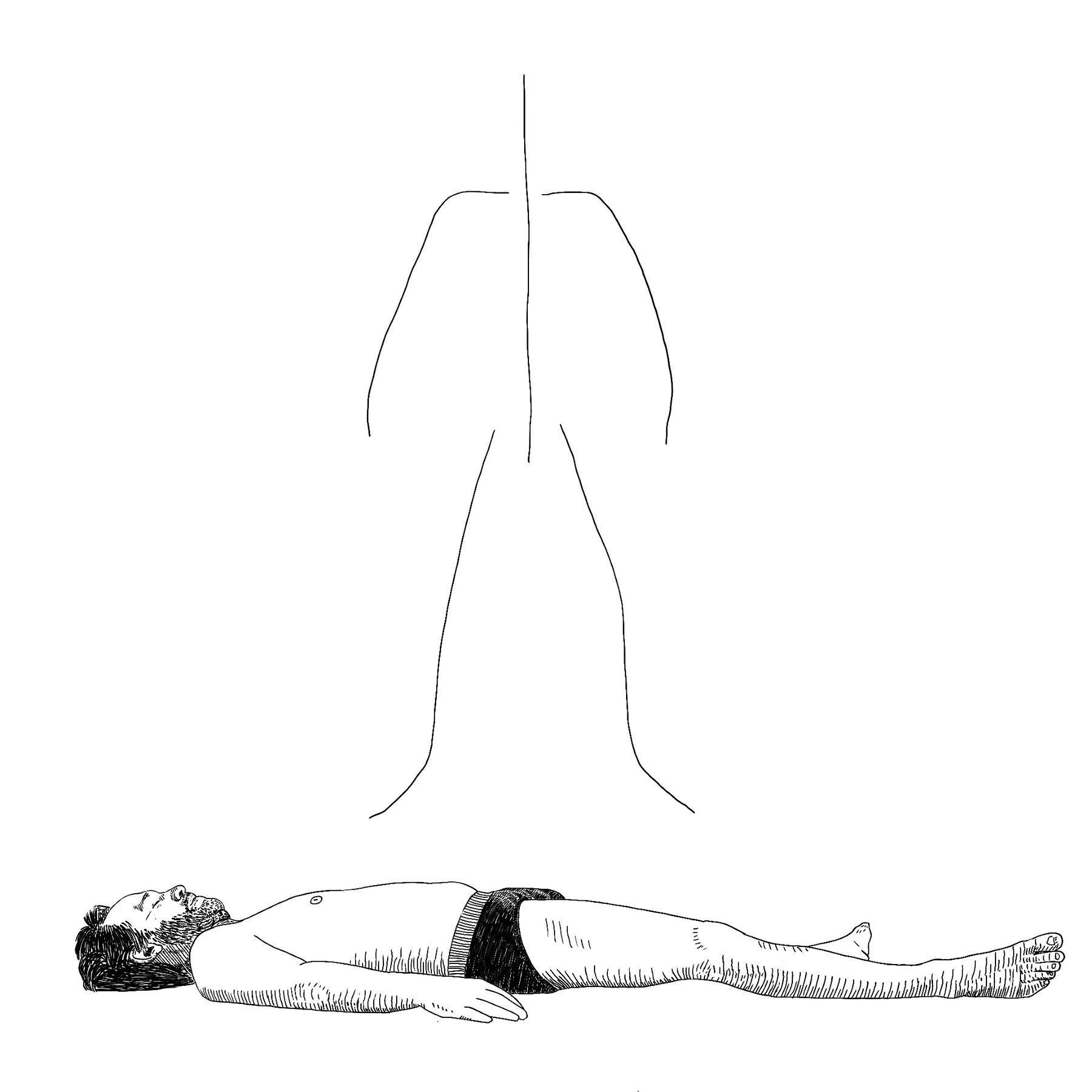
    At the same time, I’m connected with the boy through my hands. He’s been calmly lying on the table while his mother and I have been talking, and in contrast to his usual restlessness, right now he’s still. In relation to the emotional dance of our adult discussion (about him), right now he’s calm.

    Is he listening to us talk about him? Surely, he must be. Which bands of the conversation is he tuning to?

    When I start to listen to him through my hands, I feel surprised. I tell his mother. “He’s so quiet right now. Like nervous-system-wise.”

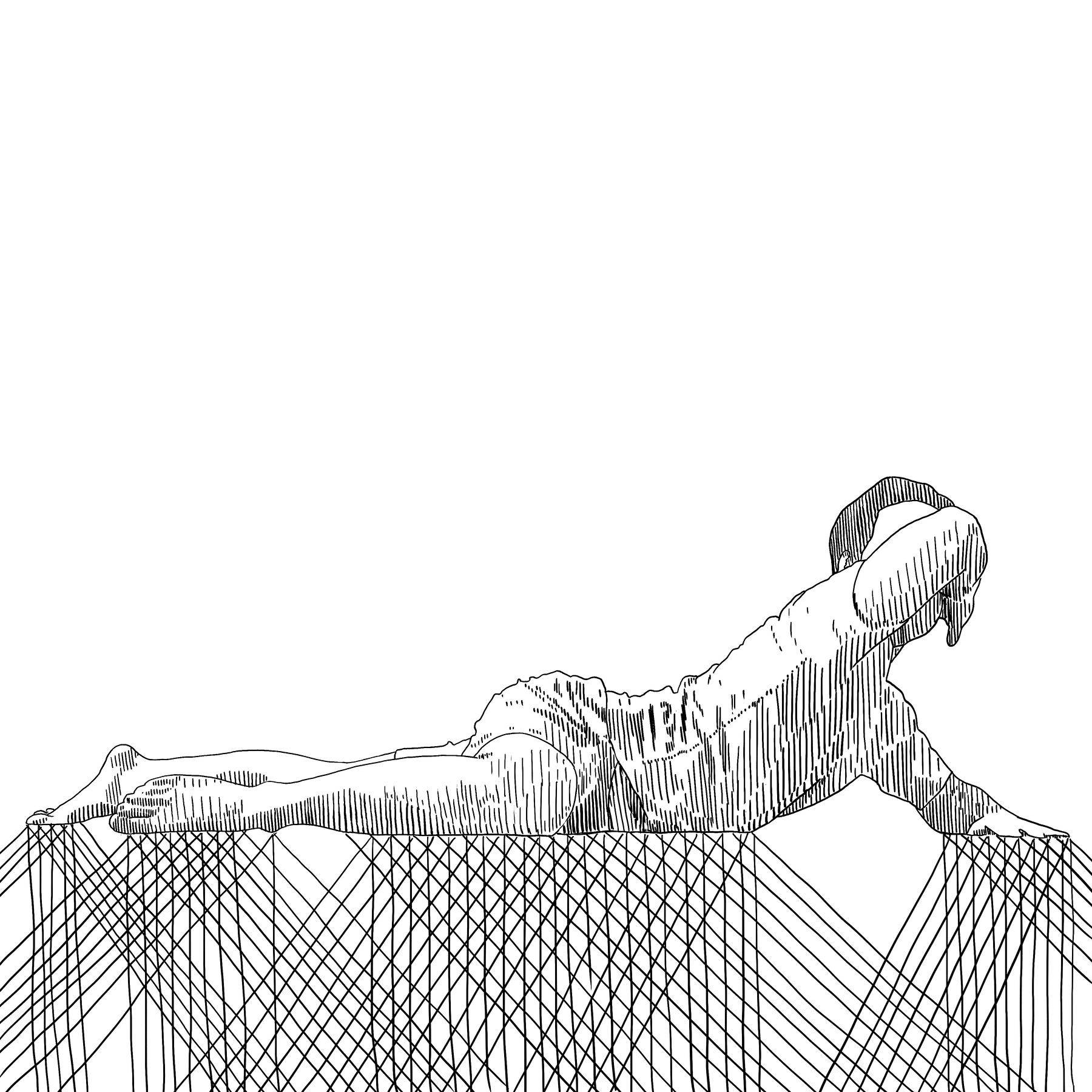
    My focus has shifted from working in the mom’s register, which is an important here-and-now, to second here-and-now of the boy’s movement world. And of course there’s my here-and-now, which makes three.

    The three heres and three nows are linked up in this moment, with the three of us being more of less aware how.

    I’m saying, “Look, it’s actually pretty nice in this movement world right now.”

    I point it out because maybe her here-and-now will feel different if she connects with him in a moment of calm, openness and ability to learn. Those are the things I’m hoping will grow and develop, in all three of us.

    → 12:14 PM, Apr 1
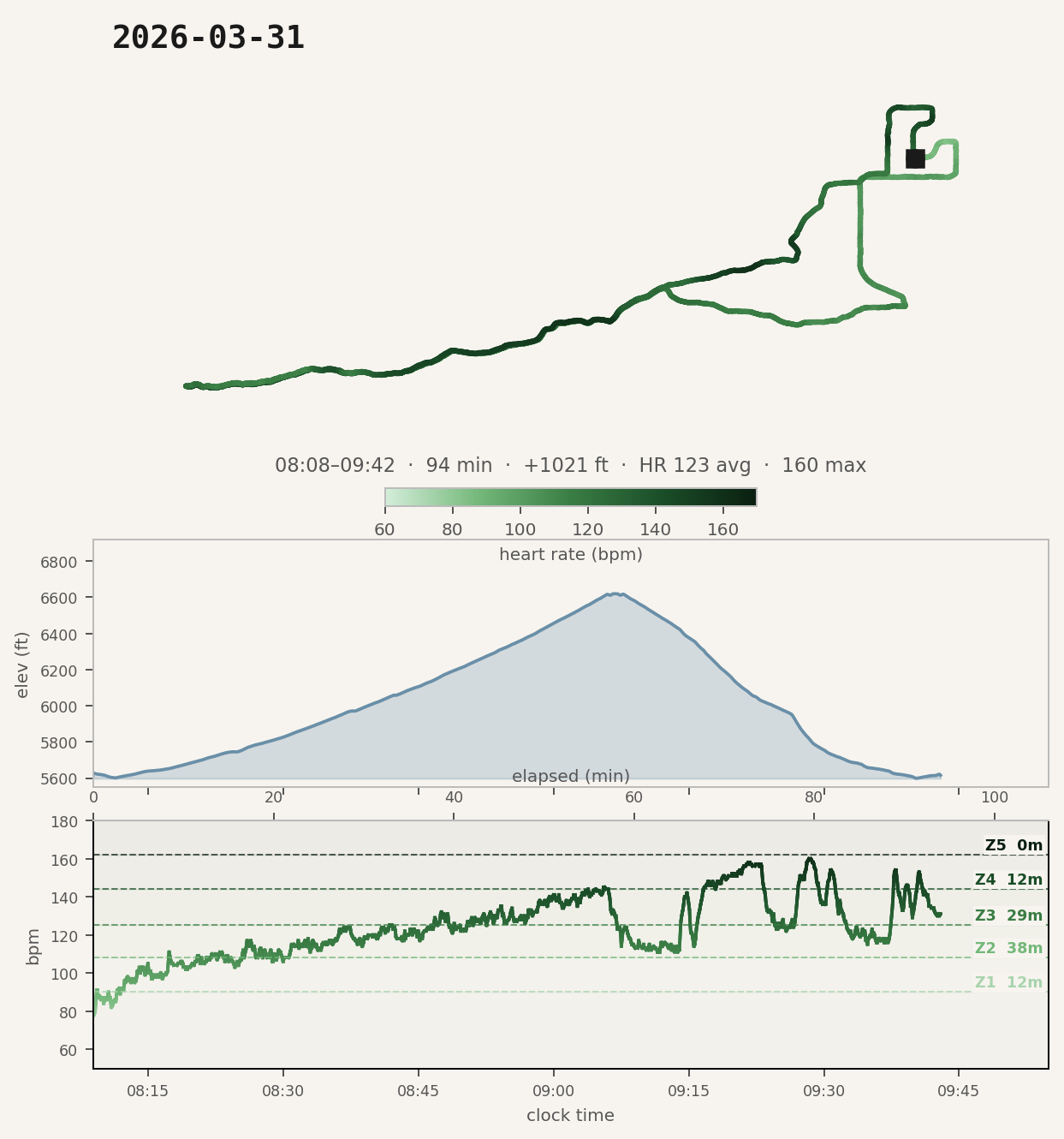
  • Went on a hike this morning then vibe coded a map making script that puts together gpx and heart rate data.

    → 11:38 AM, Mar 31
    Also on Bluesky
  • I just finished reading: Shu Ha Ri by Richard Griffiths @writingslowly

    I liked how short it was. I think it would fit in well with other books from Tracy Durnell’s In praise of the hundred page idea.

    Shu Ha Ri is about learning through lineage, then keeping lineage alive. I liked the weave of examples from different ways (dōs) that run through the book. Most touching was the story of Jigoro Kano, founder of Judō, whose final request in life was to be buried wearing his white belt. I had already heard a fair bit about Kano because Moshe Feldenkrais studied with Kano, so Kano feels like an ancestor in the Feldenkrais lineage I’m practicing in. But I had never heard this detail about Kano’s intention to maintain beginner’s mind even after going through death.

    I also appreciated the explanation of Keiko, a word for training that includes reference to 10 generations of practitioners before. It had me thinking about how lineage holders actually want an endlessness for their practice, for the “living knowledge” or the meme of the practice to go on and on.

    → 6:07 PM, Mar 29
    Also on Bluesky
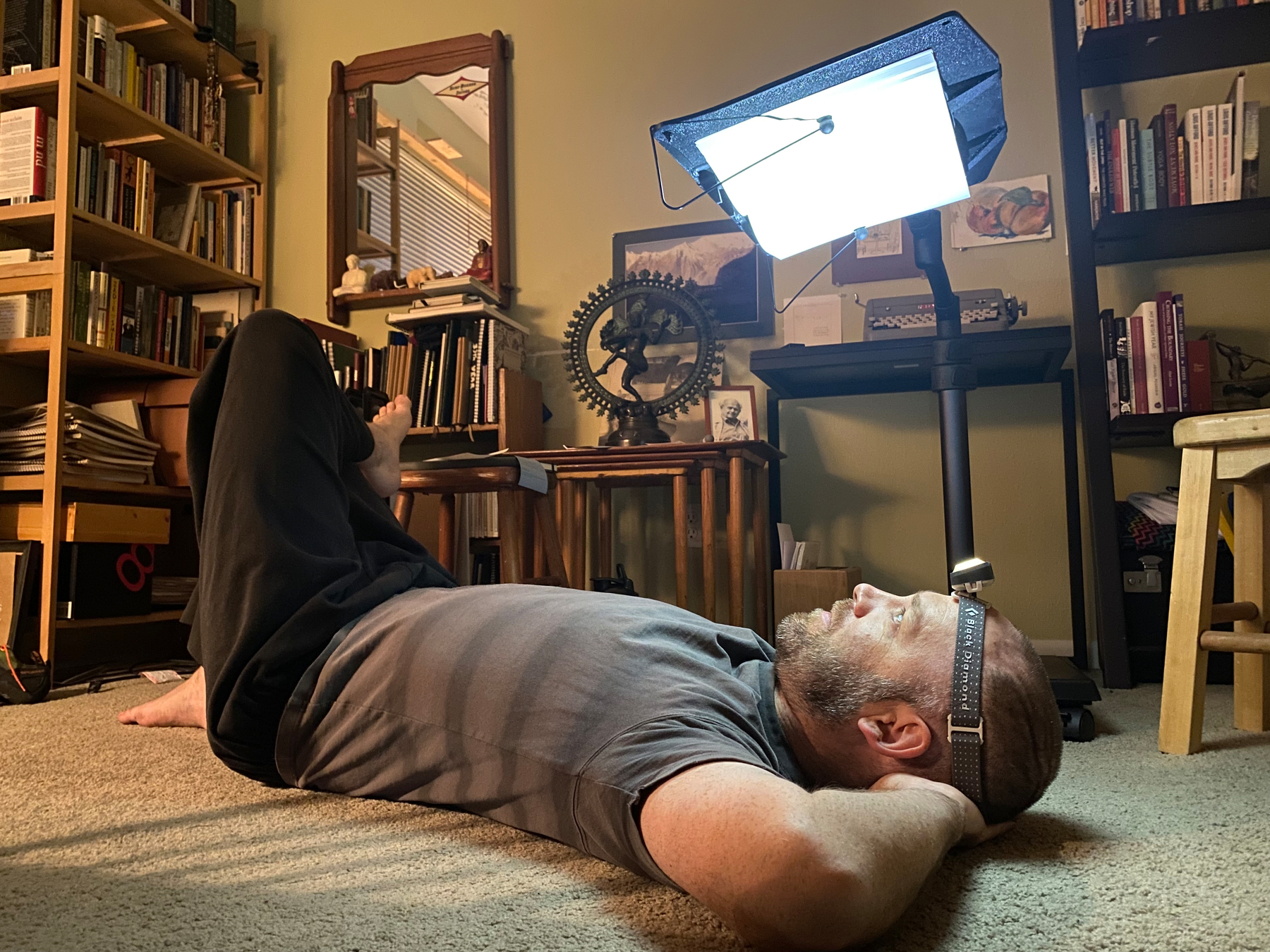
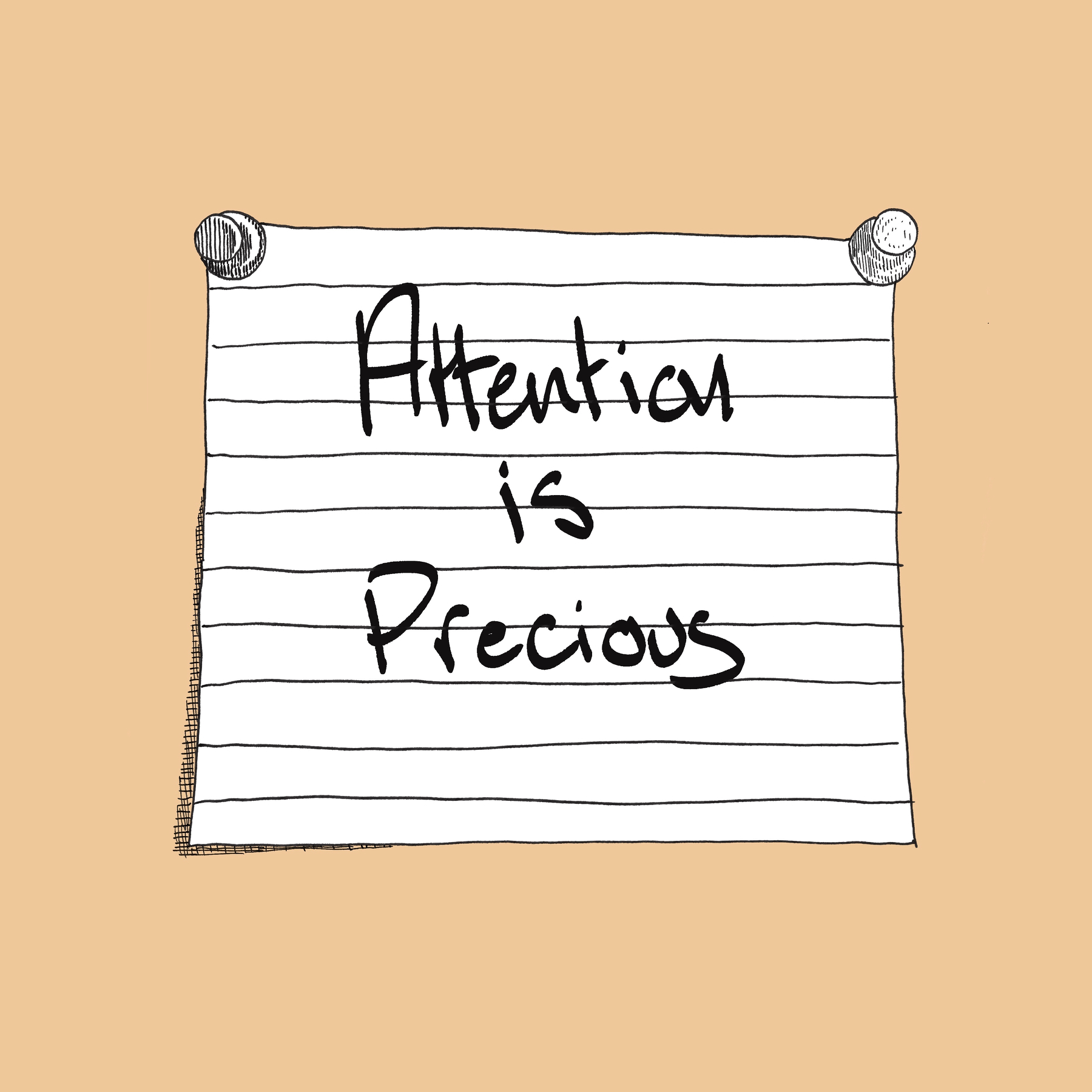
  • Attention is Precious

    → 7:48 AM, Mar 29
    Also on Bluesky
  • Turns out I started blogging in 2007

    In 2007 I graduated from college and started blogging on blogger.com. I had one called Ethan Brand Development and another one called Acade-Me.

    I only published that first summer. In the fall, I started more blogs but never published, just made drafts. Basically journal entries. I won’t bring the drafts forward onto my website now, but I’m definitely keeping them in my files for reference. Some juicy, personal stuff in there. Can’t believe it’s all still just sitting in blogger.com.

    → 6:04 PM, Mar 26
    Also on Bluesky
  • I’m thinking about retro-actively assembling my personal website as an archive of lots of previous stuff I did, including stuff I already posted online, which is what Lisa Charlotte Muth did bringing everything back to her website, but ALSO maybe some stuff I haven’t posted before.

    → 1:35 PM, Mar 24
    Also on Bluesky
  • Esalen 3

    → 4:54 PM, Mar 19
  • Esalen 2 - Scanning and 5 Lines

    → 4:33 PM, Mar 18
    Also on Bluesky
  • I want to write a book

    I don’t know why. I’m not sure what it would be about. Plus I know it’s a BIG project and I don’t really have much training. But this desire to write a book just keeps coming up in my life.

    And since I’m not getting any younger, I figure I might as well be honest with myself and try to get into it while I have time.

    Most of the writing I’ve done until now has been in my journals. And like most people, I’ve also done a little bit of online posting, here and there, but nothing much of note.

    But then every once in a while, this bigger desire comes along, to do a bigger project, and it’s always a feeling that just has this general shape, like, “I want to write a book.” And typically, when this happens, I rush into a headspace full of mental furniture and start arranging and rearranging, like guests will be arriving soon.

    Sometimes, I’m vaguely aware this inner book fantasy must have something to do with my outer life. What’s going on with me that this is the shape of desire that keeps suggesting itself? A book shaped desire. But then, pretty quickly that hint of perspective turns out to be fleeting and flown.

    And again, I’m not sure what I want my writing to do for me, or what I can do for my writing. I think I need to train if I’m going to make it to the top of this book mountain that I seem to be wanting to climb.

    I know there are many ways to write: essays, novels, scripts, notes, journalism, blogging, all the sub-genres therein.

    I’m not sure what my book would even be about. I’m not sure why my thing would even need to be a book. I don’t know why.

    With everything going on in 2026, I feel strange. And haven’t there been enough books already? But I didn’t get my chance yet.

    So, here I am, apparently, setting my sights on the top of book mountain. And I guess if I ever make it up there, to the top, I’m probably gonna end up like the bear in the song… to see what he could see.

    → 1:44 PM, Mar 18
  • One of my top contenders for 2026 slogan of the year (it’s early yet, but this does a lot of conceptual work for me).

    → 10:39 AM, Feb 18
  • Esalen 47 - Public Class Sitting Twist

    → 5:00 PM, Feb 4
  • Esalen 32 - Measuring

    → 5:02 PM, Jan 21
  • Esalen 30 - Bridge

    → 2:04 PM, Jan 19
  • Esalen 29 - Toes

    → 5:06 PM, Jan 18
  • Esalen 26 - Foot Above the Head

    → 8:07 PM, Jan 14
  • Unwrap the Present - Perfect Hinges

    → 12:13 PM, Nov 25
  • Mia and Gaby SF Evenings 1978 - 1 - Coordinating Flexors and Extensors

    → 5:11 PM, Oct 6
  • Circling on the Ear

    → 5:09 PM, Aug 7
  • “the practice is for me,” a mantra I discovered and used for a little while during one of my trips to Denmark - even tho I’m working with others, the practice is for me.

    I like how the five line figures look like writing

    lesson from Alan Questel’s Reversibility, 3rd lesson, “Falling Reversibility”

    → 7:51 AM, Apr 24
  • Have goals? Have a hard time reaching them? Sometimes nothing stands between U and Ur goals except an inner tension that holds U back. U can learn to reach Ur truth thru inner resolution.

    U? comes from zencephalon

    → 10:38 AM, Apr 15
  • Words - 7 things worth sharing

    Hi All,

    I’m enjoying experimenting with this format, 7 things worth sharing, which is arbitrary but useful. I collect interesting tidbits throughout the week and put them in a draft post. Then on Monday or Tuesday, I try to shape it into 7 things worth sharing. This is the fourth time I’m trying it. Here are attempts one, two, and three.

    The emergent theme this week is words.

    1. One place confusion creeps into our lives is when we take “words for things.”
    • Feldenkrais pointed this out a lot. Here’s a choice quote from an interview he gave to the New Sun in 1977:

    “We take words for things, and once we got them as a thing, we find the thing doesn’t work as we wish. Because a word means a million different things to every other person.”

    “You say sad and you want me to treat sadness. I can’t treat sadness. Sadness is an expression of something—your sadness and my sadness and his sadness are three different things. Everybody’s sadness is a different thing. I will never be sad for the same thing as you. Therefore, when you say sadness, I can’t do anything to sadness. But, a person being sad, I can do something to the person: how does he behave to bring about sadness?”

    “NS: But isn’t there a difference when you’re working with, let’s say, old age and with the whole group of problems associated with old age: rheumatism, arthritis … MF: No, you’re mistaken. When you say that, you again make words into things, as if arthritis and old age go together. NS: So instead of saying, “I have arthritis; what can you do about it?” you would say, “Arthritis I don’t know about. You, I can work with.” MF: Yes, I can make you tick in such a way that you don’t have arthritis."1

    1. Then I was reading a chapter of Nachmanovitch’s book about how nouns turn words into things, but verbs do something else.

    “Nouns break the world and our experience apart, into things. Naming, and manipulating names and symbols, has enabled the lion’s share of our advanced civilization. But in our love of and reliance on language, we tend to confuse the name with the thing named.”

    But verbs, on the other hand, emphasize process.

    “Christopher Small, a musicologist, suggested that people fundamentally distort music by treating it as a thing; he wanted to get rid of the noun music and replace it with the verb to music, or musicking. Musicking is the real-time activity of grabbing instruments and playing, singing, writing, hearing, tapping on kitchen utensils, dancing. At the moment of listening to a concert, recording, or broadcast, people are linked in participation with others near and far, including the performers. Musicking reframes song as an activity taking place in a particular time and context; it is a process."2

    1. Another example from Feldenkrais: “You haven’t got the body. You’ve got the mind and the body, a brain and the body. And none of them can exist or function without the other. Then it’s not the body, it’s you. We say ‘your body’ ‘my body,’ as if I can sell it or change it. Or I can go away and leave it somewhere. Or change a piece which is broken. If it’s your car, you can fix it. If it’s your horse, you can sell it. But if it’s me or you, none of us can do that. Therefore it’s not our body, it’s we. It’s myself."3

    So maybe instead of using the word body, we could say we’re all currently body-ing?

    1. But then I realized it’s not just individual words—not just nouns or verbs—but sentences. Because we’re always putting nouns and verbs together. And sentences into paragraphs, and paragraphs into longer things. If we record or write down enough of them maybe we end up with an essay or a novel, or at least a Substack post.

    There’s an amazing book by Verlyn Klinkenborg called Several Short Sentences About Writing, where he focuses on what makes good, powerful sentences that do amazing things:

    “As a reader, you know the feeling of looking up after eighty pages and wondering how you got there,

    The sense of immersion, of entering a shared but private space.

    All the authority a writer ever possesses is the authority the reader grants him.

    Yet the reader grants it in response to her sense of the writer’s authority."4

    1. So after reading that, I was on the lookout for authority in sentences, or should I say sentences that authoritize? And I found an interview where Tim Kreider talks about why a certain phrase of his—“the mortifying ordeal of being known”—had enough authority to become an internet meme. I thought this was worth sharing because it shows how it’s not just the meaning of the words but the sound of the language that makes it powerful: “Euphony and cadence are the only areas in which the very abstract symbolic system of writing gets to exploit the subrational sensory pleasures of music, sneak in past the left brain and move us on levels to which other art forms have more direct access."5

    Does that make sense?

    1. Back to confusion. One place confusion creeps in is when words and phrases get enmeshed with images, emotions, habits of thought, self-perceptions and God knows what else in a mixed-up inner experience that’s tough to tease apart.

    Con (with)

    fused (many mixed as one)

    Have you ever spent time with the sentence “I am confused,” and later realized there were just too many things going on at once? Or instead of “I am confused,” maybe it should be “I am in the act of confusing.”

    Anyway, sometimes it’s nice to have a method in such a moment. Good Feldenkrais lessons help with muscular confusion. And Klinkenborg has a method that’s very Feldenkraisian to help with confusion in language.

    Here it is.

    Are you ready?

    “Imagine sentences instead of writing them. Keep them imaginary until you’re happy with them.”

    Oh, I was so happy to see this.

    If you’re interested, try it. Next time confusion arises, try to imagine a satisfying sentence somewhere close to the confusion. It has to be a complete sentence with a subject and a predicate, and it has to be satisfying. To you. If you can’t imagine your own satisfying sentence, just be patient and try a little. Without forcing it you might eventually start to sense how the confusion is getting in the way of your satisfaction. If that doesn’t work or you don’t want to, you could also try letting sentences pour forth without imagining anything.

    1. If you’ve read this far, maybe you could put a sentence or two worth sharing in the comments below. Pre-imagined or otherwise. Maybe about this post, or really about whatever’s currently satisfying for you. All satisfying sentences welcome here. Or maybe you’ll choose to satisfy yourself some other way.

    Thanks for reading. If you’d like to support, please share with a friend.

    Your fellow in word and indeed, Ethan


    1. From the book Embodied Wisdom: The Collected Papers of Moshe Feldenkrais ↩︎

    2. From the book The Art of Is by Stephen Nachmanovitch ↩︎

    3. From Feldenkrais' Quest Workshop, first or second ATM lesson ↩︎

    4. Several Short Sentences About Writing by Verlyn Klinkenborg ↩︎

    5. From Tim Kreider’s essay The most important thing was never to get a real job ↩︎

    → 2:32 PM, Dec 18
  • Practice - 7 Things Worth Sharing

    Hi All,

    Here are 7 things worth sharing this week.

    1. Stephen Nachmanovitch distinguishes two ideas of practice: “The Western idea of practice is to acquire a skill. It is very much related to our work ethic, which enjoins us to endure struggle or boredom now in return for future rewards. The Eastern idea of practice, on the other hand, is to create the person, or rather to actualize or reveal the complete person who is already there. This is not practice for something, but complete practice, which suffices unto itself.”1

    2. Do babies need to practice? The Great Tummy Time Debate is: should parents put a baby on their tummy before the baby goes there spontaneously? I don’t think babies benefit from parents encouraging them to develop movement faster. Babies are spontaneously closer to the “eastern” ideal of a whole person being revealed through indeterminate experience where everything is part of the complete practice. Of course, certain kids won’t discover movement possibilities on their own because of injury or something else. For them maybe it’s best if a facilitator can suggest movement possibilities (artfully), so the kid spontaneously has their own idea to move in a new way. Other than that, when it comes to movement it’s better to leave small children to their own learning devices.

    3. When my cousin Jac died of cancer, he left behind a bamboo flute with a strange sliced off mouthpiece. When I found it, I already had an idea what a Shakuhachi was. I’d heard recordings by Adrian Freedman that captivated me. His playing has a special quality where each moment suffices unto itself. I was listening just before my Dad started to die, so now I associate Shakuhachi with preparing for death.

    4. Last week, I thought I might like to practice the Shakuhachi, so I found a teacher near where I live. He has an interesting guide on his website, How to Practice - from David Yudo Sawyer:

    • Don’t Warm Up
    • Don’t Make Mistakes
    • Play without stopping and redoing
    • Always be responsible for your sound
    • Stay friends with your instrument
    1. Here is Ursula K. LeGuin writing about her practice, waiting for characters to show up:2
    • “The times when nobody is in the landscape are silent and lonely. They can go on and on until I think nobody will ever be there again but one stupid old woman who used to write books. But it’s no use trying to populate it by willpower. These people come only when they’re ready, and they do not answer to a call. They answer silence.
    • “If I fill the silence with constant noise, writing anything in order to be writing something, forcing my willpower to invent situations for stories, I may be blocking myself. It’s better to hold still and wait and listen to the silence. It’s better to do some kind of work that keeps the body following a rhythm but doesn’t fill up the mind with words.
    • “Essays are in the head, they don’t have bodies the way stories do: that’s why essays can’t satisfy me in the long run. But headwork is better than nothing, as witness me right now, making strings of words to follow through the maze of the day (a very simple maze: one or two choices, a food pellet for a reward). Any string of meaningfully connected words is better than none.
    1. In another post, I said a practice doesn’t necessarily answer the question, how will I pay the rent? But a practice can answer the question, What can I do so my life is worthwhile to me?

    2. “Practice is a repertoire of procedures we invent for ourselves.”3

    • What are you practicing these days?
    • When was the last time you practiced?
    • What would you like to be practicing?

    Thanks for reading. This newsletter is one aspect of my practice I hope is useful. Let me know! If you’d like to support, please share with a friend.

    Your fellow in practice

    Ethan


    1. Free Play: Improvisation in Life and Art by Stephen Nachmanovitch ↩︎

    2. All UKLG quotes from “Old Body, Not Writing” in the essay collection The Wave in the Mind ↩︎

    3. Nachmanovitch, again. ↩︎

    → 1:15 PM, Dec 10
  • Practice

    Hi All,

    Here are 7 things worth sharing this week.

    1. Stephen Nachmanovitch distinguishes two ideas of practice: “The Western idea of practice is to acquire a skill. It is very much related to our work ethic, which enjoins us to endure struggle or boredom now in return for future rewards. The Eastern idea of practice, on the other hand, is to create the person, or rather to actualize or reveal the complete person who is already there. This is not practice for something, but complete practice, which suffices unto itself.”1

    2. Do babies need to practice? The Great Tummy Time Debate is: should parents put a baby on their tummy before the baby goes there spontaneously? I don’t think babies benefit from parents encouraging them to develop movement faster. Babies are spontaneously closer to the “eastern” ideal of a whole person being revealed through indeterminate experience where everything is part of the complete practice. Of course, certain kids won’t discover movement possibilities on their own because of injury or something else. For them maybe it’s best if a facilitator can suggest movement possibilities (artfully), so the kid spontaneously has their own idea to move in a new way. Other than that, when it comes to movement it’s better to leave small children to their own learning devices.

    3. When my cousin Jac died of cancer, he left behind a bamboo flute with a strange sliced off mouthpiece. When I found it, I already had an idea what a Shakuhachi was. I’d heard recordings by Adrian Freedman that captivated me. His playing has a special quality where each moment suffices unto itself. I was listening just before my Dad started to die, so now I associate Shakuhachi with preparing for death.

    4. Last week, I thought I might like to practice the Shakuhachi, so I found a teacher near where I live. He has an interesting guide on his website, How to Practice - from David Yudo Sawyer:

    • Don’t Warm Up
    • Don’t Make Mistakes
    • Play without stopping and redoing
    • Always be responsible for your sound
    • Stay friends with your instrument
    1. Here is Ursula K. LeGuin writing about her practice, waiting for characters to show up:2
    • “The times when nobody is in the landscape are silent and lonely. They can go on and on until I think nobody will ever be there again but one stupid old woman who used to write books. But it’s no use trying to populate it by willpower. These people come only when they’re ready, and they do not answer to a call. They answer silence.
    • “If I fill the silence with constant noise, writing anything in order to be writing something, forcing my willpower to invent situations for stories, I may be blocking myself. It’s better to hold still and wait and listen to the silence. It’s better to do some kind of work that keeps the body following a rhythm but doesn’t fill up the mind with words.
    • “Essays are in the head, they don’t have bodies the way stories do: that’s why essays can’t satisfy me in the long run. But headwork is better than nothing, as witness me right now, making strings of words to follow through the maze of the day (a very simple maze: one or two choices, a food pellet for a reward). Any string of meaningfully connected words is better than none.
    1. In another post, I said a practice doesn’t necessarily answer the question, how will I pay the rent? But a practice can answer the question, What can I do so my life is worthwhile to me?

    2. “Practice is a repertoire of procedures we invent for ourselves.”3

    • What are you practicing these days?
    • When was the last time you practiced?
    • What would you like to be practicing?

    Thanks for reading. This newsletter is one aspect of my practice I hope is useful. Let me know! If you’d like to support, please share with a friend.

    Your fellow in practice

    Ethan


    1. Free Play: Improvisation in Life and Art by Stephen Nachmanovitch ↩︎

    2. All UKLG quotes from “Old Body, Not Writing” in the essay collection The Wave in the Mind ↩︎

    3. Nachmanovitch, again. ↩︎

    → 12:15 PM, Dec 10
  • Artisanal Bones - 7 Things Worth Sharing This Week

    Hi All,

    Here are 7 things worth sharing this week:

    1. Artisanal Bones. Have you ever thought “there’s something unusual about my body”? Maybe you felt embarrassed or didn’t want anyone else to know? Even if not, check out this amazing post from Kari Dru about “artisanal bones.” The replies are so encouragingly full of people telling unusual dimensions of themselves, outside-the-norm starts to seem normal.

    2. Names of Bones. When anatomy gets taught in school, all the bones have latin names, but what do the names actually mean? They sound fancy, but a lot of them are actually imagistic and folksy.

    • Tibia, the load bearing bone in the lower leg, means “Flute.”
    • Fibula, the other bone in the lower leg, means something close to “Clasp,” which has to do with holding the ankle together.
    • Scapula, the technical term for shoulder blade, means “shovel” or “trowel.” Yeah, shoulder shovel :)
    • Clavicle, what we call the collar bone, means “key.” Bonus points if you can move your arm to feel the “key” bone turning. I haven’t figured it out (yet).

    3. Simple vs. Complicated Words. When and why should we choose complicated vs. simple words to describe parts of ourselves? I love this 1993 explanation from Feldenkrais trainer Mark Reese: “If you look at young children, the language they learn for the parts of the body usually are more Germanic rather than Latin. Like foot and neck and back. Those are more basic words and they are sensory based, whereas the words you learn in school are more anatomically based and may have a particular role in situations like surgery or navigation. But we learn these technical things later in life. They are not sensory based in the same way that the basic words like back or rolling or sliding or pushing or pulling. Those are words you learn when you are two years old.” So better to use simpler words when we want to talk to deeper, more youthful parts of ourselves.

    4. Start a Dance Group. The holiday season in the US (Thanksgiving) reminded me of something very simple and useful I want to share, because it was shared with me, which is: You can start a dance group. You can meet every week, even with one other person, to dance. And dance relationships nourish like nothing else. Tumblebones here in Boulder have been dancing with each other every week for the last 20 years. The Boulder Contact Lab has similar longevity. A small core of people meeting regularly to dance can do amazing things for the broader community. May I humbly suggest you find your local dance group? If you can’t find one, please start one.

    5. True Dance is Always Local, in Real Life.

    • When was the last time you danced?
    • Who is the last person you danced with?
    • If you were going to start a dance group, who would be your first invite?

    6. Betweenius. In the midst of my dancing, reading, and thinking this week, Betweenius arrived in my head. Betweenius is an alternative to Genius and a sub-species of Brian Eno’s Scenius (click and go to minute 30 for Scenius explanation). Betweenius is the name for when the connected actions of two people spark a third surprise type of thing neither would have done alone. Betweenius is easily recognizable in dance, also in love making, music making, acting, and child-caregiving. Any activity where two people are playing together.

    7. Just for Fun. I’ll end on a recommendation note and recommend Your mum does the washing by Joshua Idehen which made me laugh out loud.


    Thanks for reading. This newsletter is an ongoing work of love made real by many little movements of my fingers on a keyboard. If you’d like to support, please share with a friend.

    Touch the ground, Dance forever! (the Tumblebones motto), Ethan

    → 8:23 PM, Dec 2
  • Everything is Dance

    Hey All,

    Here are 7 things I thought were worth sharing this week:

    1. Steal Like an Artist is a fantastic book by Austin Kleon. He writes, “How does an artist look at the world? First, you figure out what’s worth stealing, then you move on to the next thing. That’s about all there is to it. When you look at the world this way, you stop worrying about what’s ‘good’ and what’s ‘bad’—there’s only stuff worth stealing, and stuff that’s not worth stealing.” Every week Austin sends out an email with 10 things he thinks are worth sharing. I guess you can’t steal what is shared, can you? But, I’m stealing his format for this post, paring his 10 things down to 7.

    2. The 20th century German artist Joseph Beuys claimed “Everyone is an Artist,” which sounds a certain way to you and me, based on our backgrounds. But he was German in the middle of the 20th century with all that entailed, and he meant that art can/should change the social world of humans. “Only art is capable of dismantling the repressive effects of a senile social system that continues to totter along the deathline: to dismantle in order to build ‘A SOCIAL ORGANISM AS A WORK OF ART’ … EVERY HUMAN BEING IS AN ARTIST who – from his state of freedom – the position of freedom that he experiences at first-hand – learns to determine the other positions of the TOTAL ART WORK OF THE FUTURE SOCIAL ORDER.” Wow. Lots to chew on.

    3. In The Creative Act, Rick Rubin puts a 21st century, American individualist’s spin on it, replacing Artist with one of our culture’s watch-words: “Everyone is a creator.” Rubin isn’t advocating for social reform like Beuys was. “To live as an artist is a way of being in the world. A way of perceiving. A practice of paying attention. Refining our sensitivity to tune in to the more subtle notes. Looking for what draws us in and what pushes us away. Noticing what feeling tones arise and where they lead. Attuned choice by attuned choice, your entire life is a form of self-expression. You exist as a creative being in a creative universe. A singular work of art.”

    4. So even Trump’s an artist? What kind of art are we talking about? (Have you seen the sports stars copying Trump’s dance?). With politics in the air here in the USA, I’ve been revisiting a book from 2004, Don’t Think of an Elephant! by George Lakoff about how conservatives live in a “Strict Father” frame whereas progressives live in a “Nurturing Parent” frame. Strict father frame acts as though children learn through reward and punishment (like spanking); children become more self-reliant and more self-disciplined by having strict parents; and parents, particularly fathers, are meant to mete out rewards for good behavior as well as punish bad behavior. Nurturing Parents, on the other hand, act as though discipline is much more than strict, unquestioning obedience. Mutual respect and compassion are also rights. Mutual respect and compassion are best taught by example. The outside world is no more inherently hostile than it is inherently friendly. And the world commands respect. So I guess that makes Trump a Strict Father artist who dances without moving his spine to the YMCA song.

    5. Everyone is a Dancer. Everything is Dance. I think these are useful, not true statements. It’s undeniable that gravity is a law to which we are all subject, from the moment we leave the womb. But what do you do with what you’re given? How do you interpret the law of gravity? It’s up to you. I’m suggesting you could think, “I am a dancer,” and that might be useful, if not true (yet).

    6. I wrote a facebook post a while ago about how maybe my work with kids is dance.

    7. The American choreographer Deborah Hay has an amazing book called my body, the buddhist, where she shares, among other things, some incredible dance koans that really broaden the definition of dance. Koans like:

    • What if where I am is what I need?
    • What if alignment is everywhere?
    • What if your teacher (your 53 trillion cells) inspires mine?

    Thanks for reading. This is a figment of imagination made real by little movements of fingers on a keyboard.

    keep dancing, Ethan

    → 2:12 PM, Nov 25
  • RSS
  • JSON Feed